
Feathered maggots
Beautiful, but they make me see red

Bold as brass he walked past me while I was admiring our new orchard. He doesn’t realise how much I resent his presence on my piece of turf. I’m lucky I now have just one cock and a few hens breeding here. I hope the Fox deals with all of this year’s chicks and the parents croak it through old age.
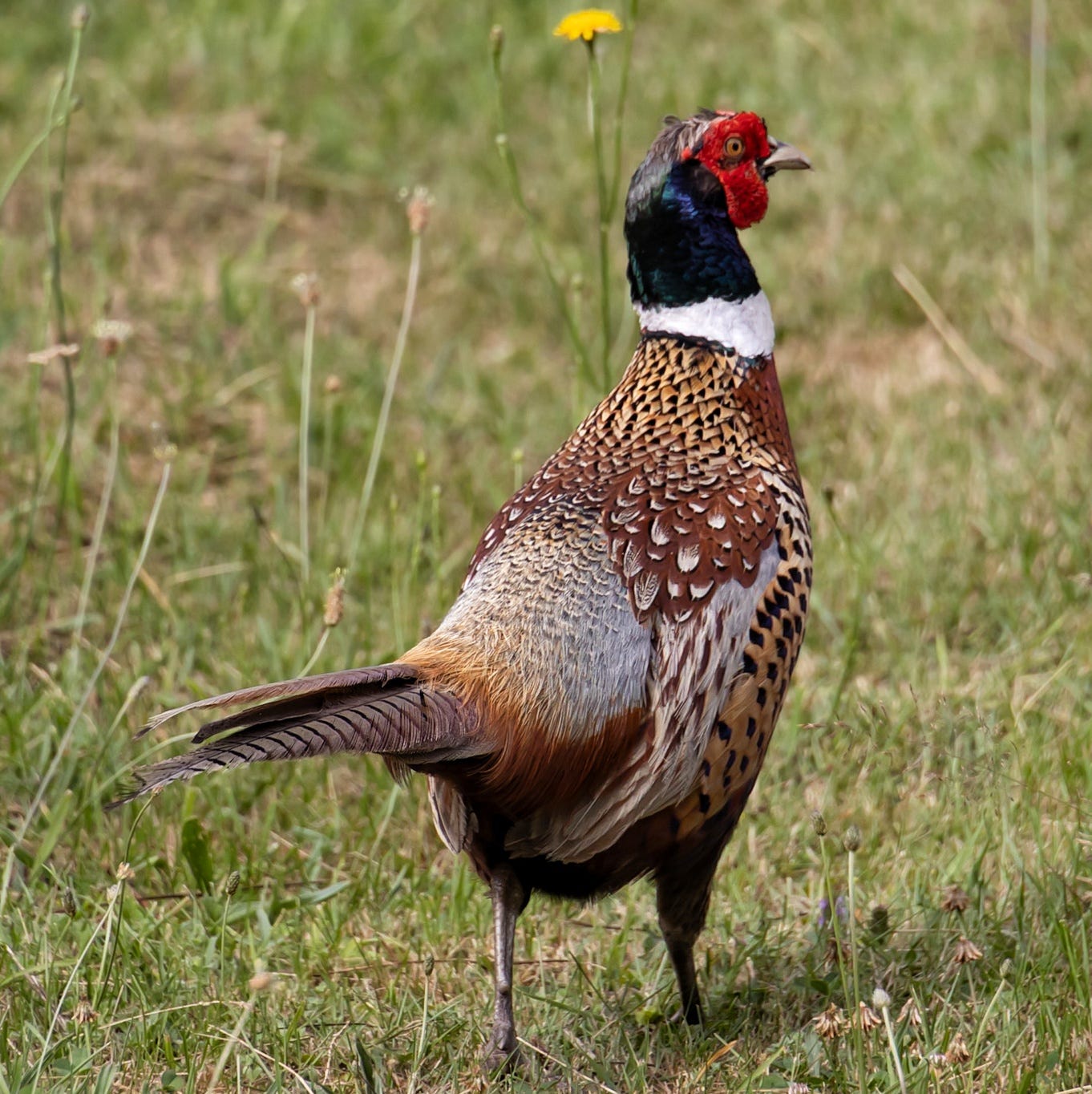
Every year after the shoots started on the big Estate we would suffer a mini invasion of the ones that got away. Thankfully there are less shoots around here than there were. Our current resident Pheasants arrived a few years ago, unlike previous invaders they seem able to successfully rear a brood each year which is worrying.
‘One of the penalties of an ecological education is that one lives alone in a world of wounds. Much of the damage inflicted on land is quite invisible to laymen. An ecologist must either harden his shell and make believe that the consequences of science are none of his business, or he must be the doctor who sees the marks of death in a community that believes itself well and does not want to be told otherwise.’ - Aldo Leopold
I did have an ecological education and it is true there are things I see around me that seem to be invisible to most of the population. The woolly maggots of the hills (sheep) have wrought havoc on our uplands. I see devastation where others see majestic rolling hills. It is made worse by having seen in mainland Europe, eg. Romania how things could/should be … productive lowlands merge gently into endless wooded hillsides and scrubby patches fading into the area above the tree line.
Pheasants in our countryside are at least as damaging as sheep in the uplands and it frustrates me that nothing is being done to deal with this sorry state of affairs.
The Feathered Deluge: The Unintended Cost of Britain’s Released Pheasants
Walk through the British countryside in late summer, and you are almost guaranteed to encounter them: explosive flurries of copper feathers, erratic squawks, and a distinct lack of road sense. The common pheasant (Phasianus colchicus) is so deeply woven into our rural tapestry that it is easy to forget they are not native.
Originally introduced by the Normans (or possibly the Romans) as an exotic table bird, the pheasant has transitioned from a naturalised novelty to the backbone of a massive commercial shooting industry. Every year, between 40 and 57 million pheasants (probably fewer in 2026) are reared in captivity and released into the British countryside.
While this annual release is celebrated by the shooting community as a traditional rural pursuit that funds woodland management, it represents a massive, unnatural ecological intervention. The sheer scale of this “feathered deluge” is fundamentally altering British ecosystems.
1. The Biomass Imbalance
To understand the impact of these birds, we have to look at the numbers. At the peak of release in August, the sheer weight of these non-native gamebirds is staggering.
According to ecological reviews, the biomass of released pheasants and red-legged partridges in late summer is greater than the biomass of all native British wild birds combined.
We are dumping millions of heavy, hungry, non-native ground-feeders into a countryside already struggling with habitat loss and climate change. The sheer physical pressure of this sudden population spike places an immediate strain on localised ecosystems, particularly around woodland edges and release pens.
2. Direct Damage: Ground Flora and Reptiles
Where pheasants congregate, the local environment changes rapidly. Within and immediately around release pens, the direct physical and chemical impacts are highly visible:
Soil Eutrophication: High densities of birds lead to a heavy accumulation of droppings. This dramatically increases soil nitrogen and phosphorus levels, encouraging aggressive, nutrient-loving weeds like nettles and docks to choke out delicate native wildflowers and ancient woodland flora.
Trampling and Scratching: Pheasants are active foragers. Their constant scratching destroys fragile forest floor structures, stripping away woodland mosses, lichens, and germinating seedlings.
Predation on Vulnerable Fauna: While adult pheasants rely primarily on grain and plant matter, they are opportunistic feeders. Before they begin their winter dormancy, native reptiles—such as the common lizard, slow worm, and even young adders—fall easy prey to these large, always alert to a meal birds.
3. The Predator Bonanza (An Indirect Ecological Trap)
Perhaps the most devastating impact of the pheasant release is not what they eat, but what eats them.
Of the tens of millions of birds released each year, only about 30% to 40% are actually shot. The rest face a grim fate: they are ill-prepared for the wild, meaning millions die of exposure, starvation, disease, or are run over on country lanes.
This creates a massive, year-round buffet of high-energy carrion and easy live prey. This artificial “food subsidy” fuels a dramatic spike in generalist predator populations, particularly foxes, carrion crows, and magpies.
[40-57 Million Pheasants Released]
              │
              ▼ (Only ~35% Shot)
[Millions of Dead/Vulnerable Pheasants] ──> [Abundant Carrion / Easy Prey]
                                                       │
                                                       ▼
                                          [Surge in Fox & Crow Populations]
                                                       │
                                                       ▼ (In Spring)
                                  [Unsustainable Predation of Ground-Nesting Birds]
When spring arrives and the easy winter supply of pheasant carcasses dries up, these artificially inflated predator populations do not simply disappear. Instead, they turn their attention to native wildlife. Vulnerable, declining ground-nesting birds—such as curlews, lapwings, and golden plovers—bear the brunt of this pressure, as their eggs and chicks are systematically hunted by an overabundant army of foxes and crows.
A Call for Balance
The argument surrounding gamebird releases is often polarized between those who value the habitat conservation funded by shoots (such as planting cover crops and preserving woodlands) and those who view the practice as an ecological disaster.
However, the science increasingly suggests that the current scale of releasing is unsustainable. If we are to protect our highly threatened native species and allow fragile ecosystems a chance to recover, we must move towards an eventual ban on artificially reared birds being released.